Savannah Cat Breed Rescue & Adoption FAQ Answered
Interview with Brigitte Cowell Moyne, Director & Founder, Savannah Cat Rescue
In addition to articles that describe a cat breed based on research, in this case Savannah Cats, I wanted to share insider and breed expert knowledge with you. I hope that this interview will help answer your every question about what life with a Savannah Cat would be like so that you can make an educated decision about whether these breeds would be a match for you and your lifestyle. The following is a summary of our conversation about the breed and breed rescue for Savannah Cats; it is a combination of direct quotes and my best attempt to paraphrase based on my interpretation of sentiment.
If after reading this and our informative article about the breed, you would like to learn more and possibly adopt a Savannah cat from rescue, then I encourage you to contact Savannah Cat Rescue directly.
Legalities of Savannah Cat Ownership
Summary: Varies By State So Check The Map
“Here in the State of California they go by the Federal ruling, which is, if one parent is a domestic cat, the offspring are a domestic cat. So in California everything from the f 1 which is the 1st generation cross of a serval and a domestic cat, is considered domestic.
Most states in the Us. Are like that. There are outlying States. If you go to, there’s a website, hybridlaw.org. And it lists, the States, and any sort of restrictions or bans. For example, the State of Georgia has a ban. The State of Hawaii has a ban, so that those are places that have said No, Texas is so complicated you’d think the as that would, as a State would be very like. But no, they’re.”
Although I though that a lack of spay and neuter may have influenced Texas legislation, Brigitte explained that the Texan one came out of their dangerous wild animal act where they outlawed a lot of what lions, tigers, and bear” and offspring were also slipped in there with the wording “hybrids thereof”, that got tacked into acts because people said, ‘Oh, you’re banning lions and tigers! Well, I’ve got a liger, so they’re legal. And so the lawmakers just threw in the and hybrids thereof, and didn’t think twice. Well, Savannahs are a hybrid of a serval, so if the Serval is on their dangerous wild animal list, therefore it’s restricted. But you can get permits. But it’s very complicated. And Texas is just a quagmire.
But you know, most places like Ohio did the same thing, but we [Savannah Cat Rescue] were able to catch it when it was still in the, in the passing of the bill [stage], and we were able to show them Savannahs, and they were like, ‘Why are we banning these?’ And so it got taken off. [In OH] they’ve specifically said ‘Savannah cats are a cat breed’, and there’s some states that have [said it is okay], if it’s registered with a domestic cat registry.
And apparently there is similar wording for some other exotics like Bengals.
“The State of New York has a restriction of F5 and further…”
Good Breeding
Summary: Good Breeders Are Good Team Players Who Register & Test Their Litters
And all the Savannahs “should be registered like any good breeder is registering their offspring. Brigitte estimated at least a thousand breeders in the US. So if they’re registered, there’s a pedigree, and the pedigree will show that.” Fortunately, according to Brigitte, “the majority of our Savannah breeders are responsible. They are registering. They are spay, neutering pet kittens before they place them.”
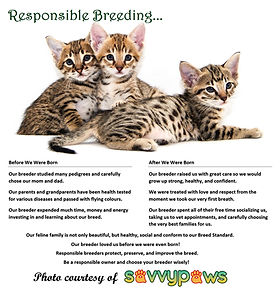
And what’s more and great to know is that Brigitte asserted “that most of our breeders actually are happy to help with rescue. They will foster any cat that’s been surrendered near them while we find them a home. Most of them [the breeders just] want to help the breed.” What’s more is that many of the breeders are also volunteering to do basic testing, which is helpful, even if more testing may be beneficial, “like heart disease, for example, which is big in the Bengal breed. It’s not as big in the Savannah breed, but it probably should be on the blood test. It should be the cardiac ultrasound. I don’t think all breeders do that. They figure. If the parents are fine, they don’t worry anymore”; even though testing “for everything they can” would probably be helpful and certainly not harmful in any way.
“You know there’s a lot of genetic tests which are pretty commonly done. Anything they could do. A mouth swap and send off, if it’s easy to get breeders to do, we find,” that most responsible breeders will do it.
What Makes Savannah Cats Special
Summary: Lovely Assistants
“Well, I think they are special, like, they look really cool, but they also that level of interaction. You know, people always throw around that ‘dog-like term’, but they do hang out with us more than most cats. They want to follow you around. See what you’re doing. ‘Help!’ They’re very helpful.” And she went on to share an anecdote of her husband working on a computer while her Savannah acted as the lovely assistant. Since “they’re the definition of curious, but they’re yes, they think they should be helping you… They’re quirky. They’re fun pets. But you’ve got to like that kind of fun”. Then she pointed out again that “They’re not for everyone. A lot of people want a pretty ornament that, you know just hangs out in their house, and they’re not that.”
Are Savannahs Good With Other Pets
Summary: Yes, If The Other Pets Enjoy A High Energy, Interactive Playmate
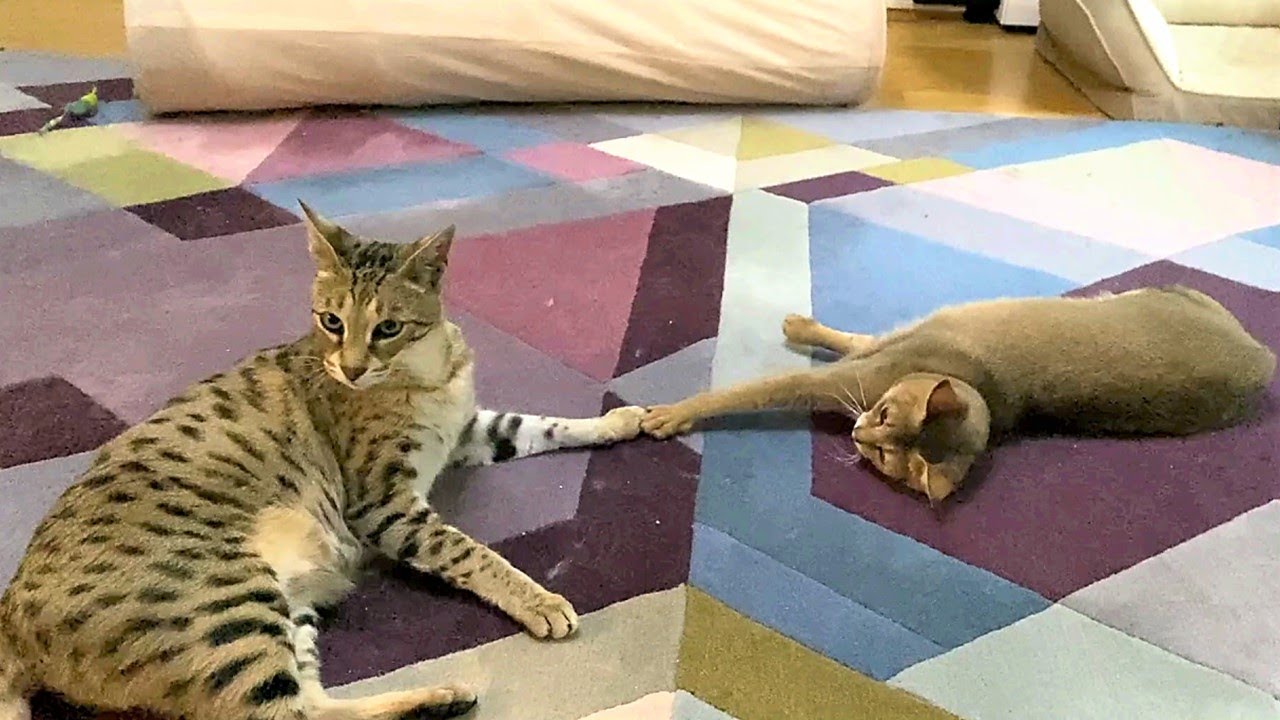
“They get along with other cats and dogs with a proviso, they tend to be a very high energy interactive breed. We say it’s very like an Abyssinian… They can be a lot of cat because of that energy and interactivity. They can be too much cat for an older, sedate cat, who just wants to be left alone in the sun patch by the window. And they come in. The cat is going. ‘Hello! You want to play, don’t you?’ You know? So they may not be for all households.
Savannah Cat Ownership Challenges
Summary: Really Know The Breed & The Current Pets In Your Household Before Committing
As described earlier “they do tend to that higher energy end of the Kitty spectrum and, you know, people need to understand that” but otherwise, they like affection, enrichment and of course a clean litter box, like just about every other cat.
Brigitte is a big supporter of breed education and strongly urges potential adopters to “do the research into the breed and the you know what personality traits, not just the looks. And as long as people do that, then they’re going to love us for that, but they need to want that kind of personality.”
She also encourages interested parties “to consider is the other pets in the household. So many people we get contacting rescue…I wish people really did consider more, you know, the needs of their other pets and what they would think. And that’s a question we are always asking, because you know if you’ve got a Chihuahua, are they gonna enjoy being the punching bag, you know, like cat going by and slapping them on the head because it’s fun, you know?” It’s hard not to laugh at that visual that sounds like something out of a animated series, but it is a very important factor to consider before adopting any other animal into a household with existing pets.
When taking in a new cat to their available rescue pool if they do not get to know the cat directly through foster, their volunteer team will “just talk a lot to the surrendering owner. We have a questionnaire for them to fill out, and we ask them specific questions from that to get a really good sense” of the cat’s personality. They even will have a potential adopter meet the cat in its original home, when possible, to reduce the shock or trauma, and so that the cat can see that the person is okay before being uprooted. That sounds like a great way to introduce the cat to a new person, which just goes to show you how important planning is, if you are going to surrender a Savannah cat, to plan ahead so that steps like these can occur.
Ideal Lifestyle & Owner Match
Summary: They Are Playful Kittens At Heart. Are You?
“[T]hey’re not a great cat for people who work long hours and just want to come home and sleep, because this cat’s going to be waiting for them, you know. So you know that that energy of them can be a negative as well as a positive. They’re always up for a game, you know. They’re always happy to play. So that’s good for some households, not good for others.”
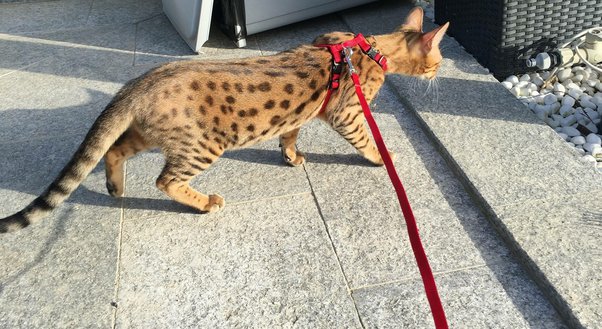
At this point I thought she was suggesting that the breed would be best suited for an active household, but she retorted that “So weirdly. Yes and no. Sometimes another [high energy] cat, like another Abyssinian or Oriental, will be great. Other times a very patient breed, like a Maine Coon or a Pixie Bob can be a good fit, too, because they don’t care if they get bugged all the time, they’ll just ignore it. So yeah, and either of the extremes… A more sensitive type of cat would say, ‘I already said, No, leave me alone’, and then you have all the hissing and spitting”.
Brigitte also pointed out that “Savannahs aren’t like most domestic cats: Once a year or two they calm down and become an adult; A lot of Savannahs never grow up. My 19 year old is still ready to jump after a 1 toy. She ain’t stopped yet, you know. She’s always ready” and isn’t great that the breed tends to be young at heart.
Supply and Demand
Summary: Be Patient and Do Your Due Diligence
“We don’t have a lot of Savannah’s surrendered here in California. We have a lot of people waiting for one, you know. That’s the problem with our rescue is because it’s breed specific. We have a lot of people waiting. And then, because it’s countrywide at the moment, we’ve had a number of cats in Florida” from possibly questionable breeders.
“The only cat I think we have in California at the moment is in Southern California, and it was actually imported from a Russian breeder,” and she was not sure why, but judging by her account, the foreign import does not seem to be the norm.
Brigitte did speculate that perhaps “it’s possibly because they got knocked back by some breeders here, and so it was easier to purchase from overseas, because that can happen in our breed, if they’re contacting responsible breeders and get told. ‘No.’ Sometimes they just find somebody who will sell [to them now].”
To avoid potentially questionable breeders, she suggests asking questions like legitimate registration papers. Her rescue group does “encourage people to really check that out, because you know, you don’t want to be spending thousands of dollars” and actually “it’s more than just money. It’s also how healthy is this cat?” Her org strongly supports education and advocates for considering more than just “cute kitten” before adopting or purchasing.
Savannah Cat Adoption Fees
“Our rescue has a general $200 adoption fee” for F1s and Savannah mixes that is sometimes lowered to $150, but there is always a fee because Brigitte feels that paying something will hopefully make people appreciate the adoption process and commitment a bit more.
Common Misconceptions
Summary: They Are Not All Crazy Big & Crazy Wild
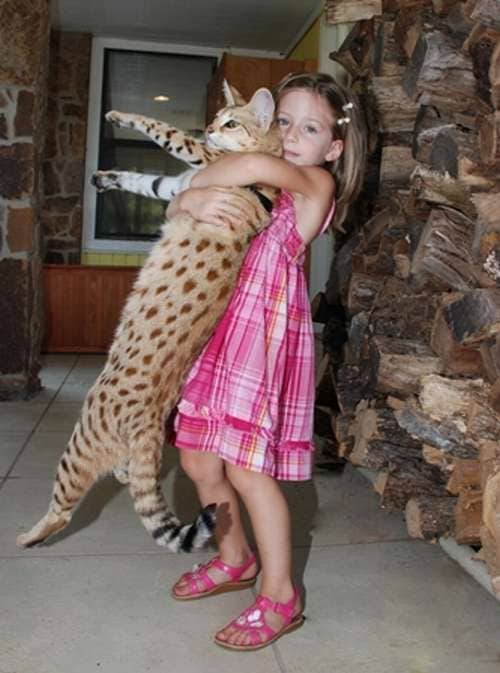
“Our biggest misconception is the whole size thing, because some Savannahs can get really large. The misconception is that all of them these huge cats.” and when some people may look online and “see a picture which is taken from a certain optical perspective, and they think the cat is the size of a Labrador” even though they are not.
“The second one would be the wild factor. Because people assume wild heritage means wild behavior, like a feral cat”… And “obviously, that’s not true. The Serval itself is not a feral behaving cat. It’s known to be the most social of all the exotic cats. So it made a good option for creating a hybrid because you started with a social cat.”
Brigitte’s One Wish
Summary: Research Behavior Not Just Looks.
When asked what she would wish for if she could wave a magic wand and change one thing, Brigitte responded: “I would say in our rescue, specifically, because we’re adopting, you know, out those very cool 1st generations through to later generations [F5]. I wish. People considered that the ones that were the first and second generation away from the Serval, [although] they might look a lot really cool, they also inherit behaviors from the African Serval. It may not be as easy a pet. They’re far more intense and determined a pet. So they’re not for all people. It’s a bit like, owning certain dog breeds, you know, you should always do the research into the behavior, not just the looks.”
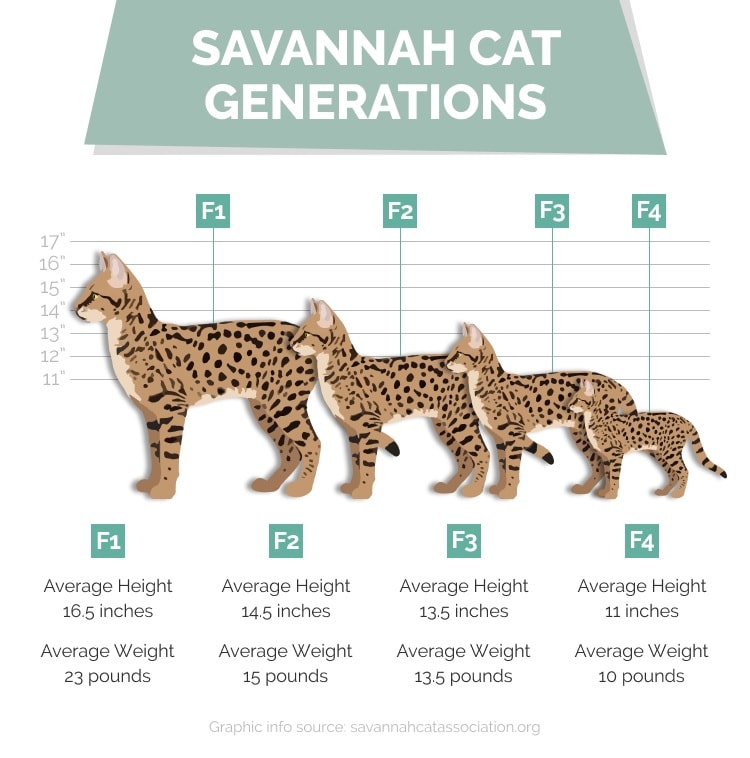
And I completely understood what she meant about being educated about the breed before adopting or buying one. Brigitte went on to argue that potential adopters “shouldn’t be choosing just for the looks. And you know we find that people are just so snowed by the look of those early generations, that they don’t consider that it’s a lot more work to have that as a pet than you know the further generations that are far more like having a very quirky domestic cat, which to me is the perfect pet.” But that may not be the case for everyone.